The Enormity of Dachau
- k8sibley
- Jul 28, 2023
- 3 min read

We try, and most of us mostly fail, to grasp the scope of the many crimes of Hitler and the Third Reich. The people who really knew, deep in their bones, just how heinous were the atrocities and actions they witnessed first hand, are fewer each year. It becomes too easy for millions to gloss over, to excuse, or to outright deny what happened in those years.
It's interesting to me that today we can board a perfectly ordinary train that will take us to a lovely town outside Munich that is the site of one of the largest death camps, where Hitler and his henchmen sent thousands of trains loaded with human beings whose only "crimes" were to be born as "others" undeserving of life. (And it is unspeakably disturbing to see political and so-called spiritual leaders throughout the world--and especially now in my own country--designate and denigrate "others" as less than human; we seem to be barrelling toward a repeat of Hitler's world).
Cindy and I went to Dachau on a chilly grey morning. We were part of a small tour group, led by a man whose name I’ve forgotten but whose passion for the subject I will always remember. This man actually moved from Ireland years ago to study and become a tour guide for this place.

The only thing I regret is that we weren't given the necessary time to take in the museum exhibits. But on the other hand, the tour, and the site itself, may have been as much as we could absorb in any case.
Dachau was one of the earliest concentration camps, built to imprison the Reich's political opponents. Initially, it was apparently not intended as a death camp, but once Himmler was put in charge, and the anti-"other" campaign was ratcheted up, the intent changed. Our guide emphasized that it was not just Jews who were sent there; sexual and ethnic minorities; Sinti and Roma; non-conformists (as broadly defined by the Gestapo and the SS)--again, anyone deemed "other" than the "pure" Aryan ideal--were sent to Dachau and the many camps that were established throughout the expanding Reich. For a while these were in fact work camps, and the prisoners were given hard (and often meaningless) labor. But Hitler and Himmler were determined to eliminate from Earth anyone who was not their Aryan ideal human. Time, power, and the eventual need on the Nazis' part to cement that power over all others changed everything.


Dachau is immense; it's difficult to imagine the daily roll call where every person (thousands upon thousands) in the camp had to report to the main square for individual calling of their numbers--no names; the moment prisoners arrived at the camp, they ceased to have names.

I really don't have many comments to add to most of the following photographs. I hope they speak for themselves.

"Work makes one free"


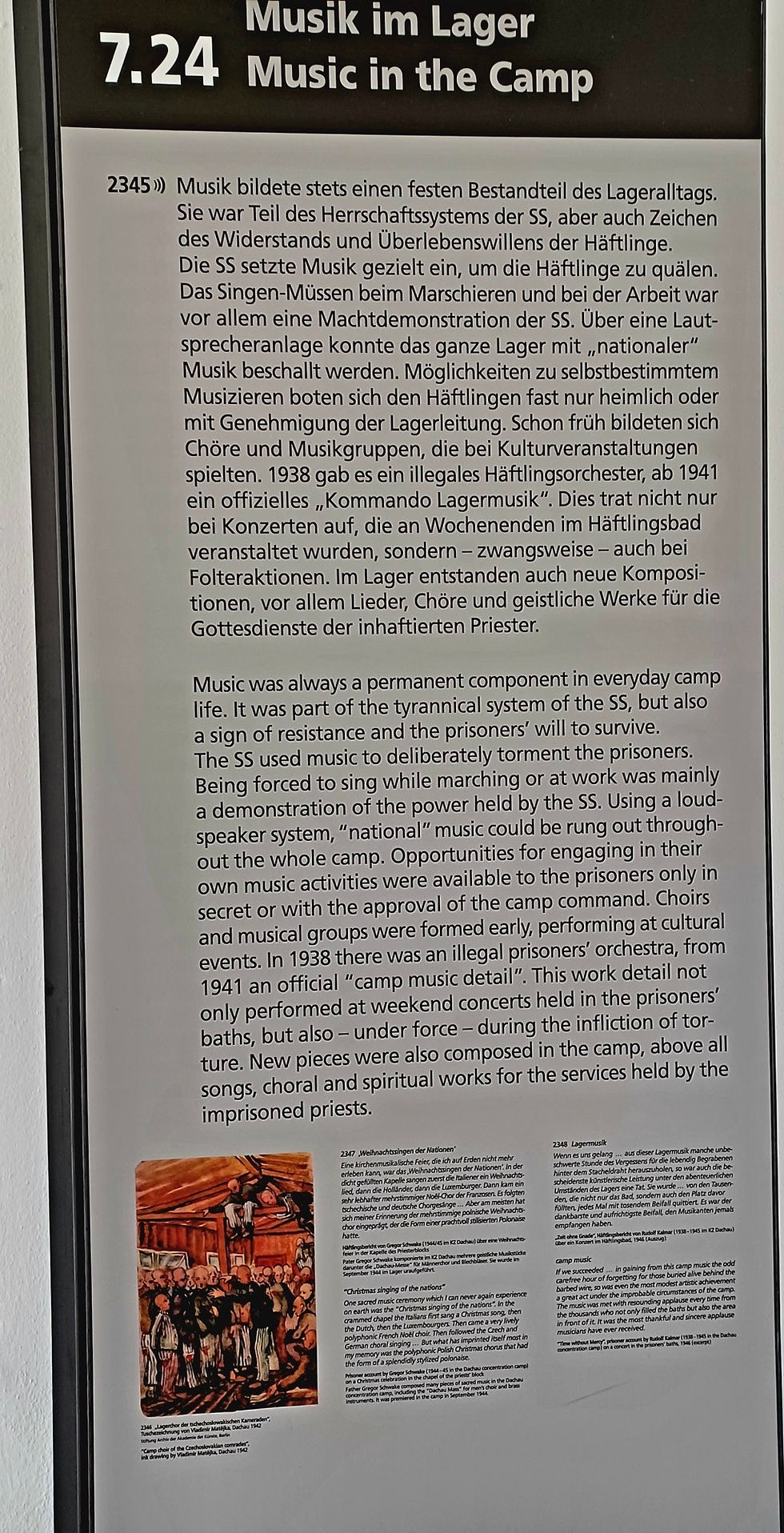
Prisoners resisted as best they could. Music, of course, was one form of that resistance. But music was also used by the Nazis as another form of torture.


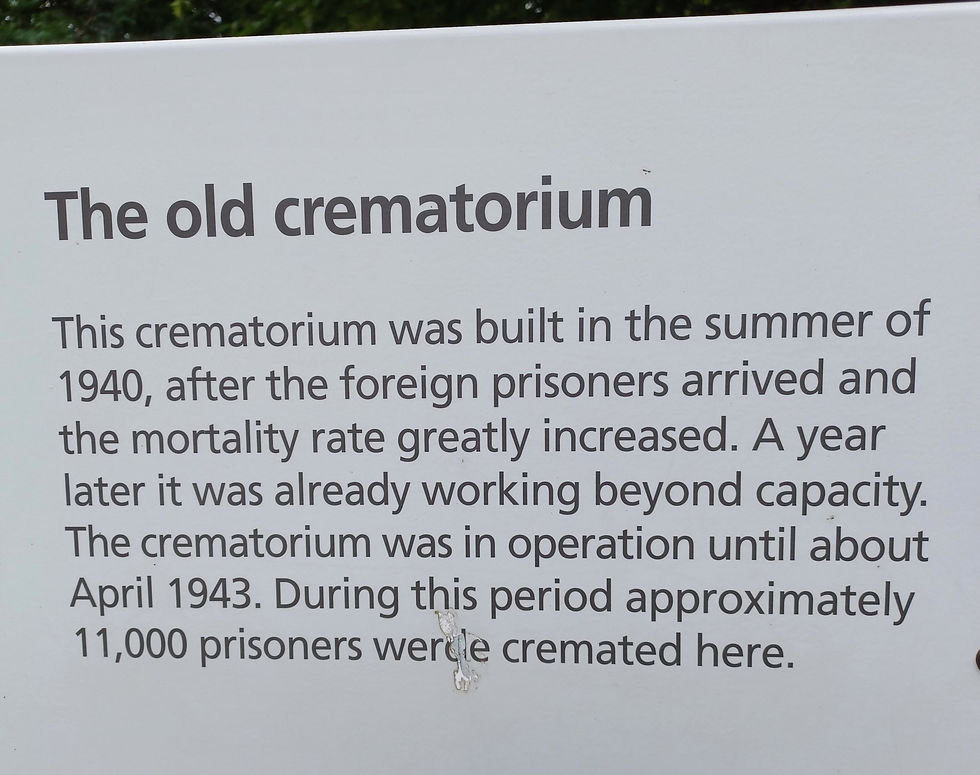


Notice how low the ceiling is (more efficient)

Hangings took place here (again, more efficient)

Inhumanity on an industrial scale
All of this makes the heart hurt beyond words.


It behooves us to remember that the Nazis' policies were based on practices established here in the States for containing the enslaved people. But they considered our practices too harsh for their tastes, so they modified them.
One last note: You might recall the brass paving stones we first discovered in Amsterdam. We found an explanation for these at Dachau:

This led us to look for these wherever we went, which resulted in another coincidental encounter in Vienna ( but more on that when I get to our Vienna chapters). This strikes me as one of the most effective public art projects I've encountered anywhere. Here's a link to further information on the stolpersteines: https://www.vice.com/en/article/7xw84a/viennas-dark-wwii-history-is-literally-embedded-in-its-streets
These stumbling stones make the past feel so present and intimate.
Understandably, I found writing this installment difficult. The enormity of Dachau, in every sense of that word, is impossible to convey, and I feel inadequate for doing it justice. But it moved us, and it left us fearing for the future of our country and the world. May we take strength from the history of Dachau and its fellow camps and strive harder to break through the racism, nationalism, homophobia, and misogyny being trumpeted ever more loudly by so many of our American politicians and factions. We can and must be better than this.
Another good link about the stumbling stones: https://www.theguardian.com/cities/2019/feb/18/stumbling-stones-a-different-vision-of-holocaust-remembrance?CMP=share_btn_link
Back to Munich for the rest of our day there; watch for that chapter next.


This one is so difficult to look at and read. Will man’s inhumanity to man ever cease. It can’t get any worse than this, or can it.
Beautiful words despite the human tragedy for which there are none 🙏.