Sing It, Cindy!
- k8sibley
- Aug 19, 2023
- 6 min read
Updated: Oct 5, 2023

July 6: Here, at long last, I'm going to meet and learn about Cindy's beloved Vienna. (Too bad I had Covid, but at least I felt okay physically.) We had a busy day ahead of us, beginning with another walk to the Vienna Staatsoper. Because it was close to our hotel, I saw this building frequently, but it was closed for the summer so never saw the interior.
As has been the case since this trip began, I was drawn to the buildings that have beautiful friezes and murals. Vienna had them, and some of them were close to our hotel. Naturally, I didn't do my research until we came home, but apparently we were in an area called Freihausviertel (Free House Quarter, I think). And here's the map of the area as it was originally, imposed on the streets as they are now:

At least that's what I surmise from looking at this mural and its title, found on the wall of a residential building.
Freihaus (Free house), by the way, is the term for public housing, in which something like 62% of Vienna's residents live. Vienna continues to be the "gold standard" for affordable living for people of all income levels--and the public housing buildings are all built around common spaces, promoting strong communities. It can be done. Socialism can work for all.
And another interesting mural nearby:

Way beyond my Google translation capabilities to come up with the story this mural tells.
But here also be dragons!

This is the Schutzengelbrunnen (Guardian Angel Fountain) in Rilkeplatz. Beautiful--and some of the best dragons of our trip.

This was one of my favorite pieces of art:

Cindy told me it is a black eagle, the Austrian National Animal, featured in the country's coat of arms (from the Habsburg dynasty). I personally thought this one looked more like a chicken from Warner Bros.--more cute than regal. But it was imposing.
And by contrast, here is a swan that looks much more fierce than that big bird:

We were on our way to Stephansplatz, to see St. Stephen's Cathedral. There were some important sights along the way (in addition to the animals you've already seen):

The Opera House (see the photo at the beginning of this chapter)
And stars of famous musicians:


These were all over the place around the Opera House, even down in the subway passageways, all part of the Music Mile:

As we made our way to Stephansplatz, Cindy and Edie were commenting on how much had changed since they lived here. Since that was 40 years ago, not too surprising--but it was quite disturbing, I think, for them to see how commercial this long plaza had become, with all the American/global chains represented.
But still...Cindy could recognize the area where she used to busk (very successfully) when she lived there. Here she was then:

And here she is recreating that time:


The tree is much taller.
From this stellar memorable moment, we moved on.
My first view of St. Stephen's, with its most interesting roof:

Here's an important part of St. Stephen's history:
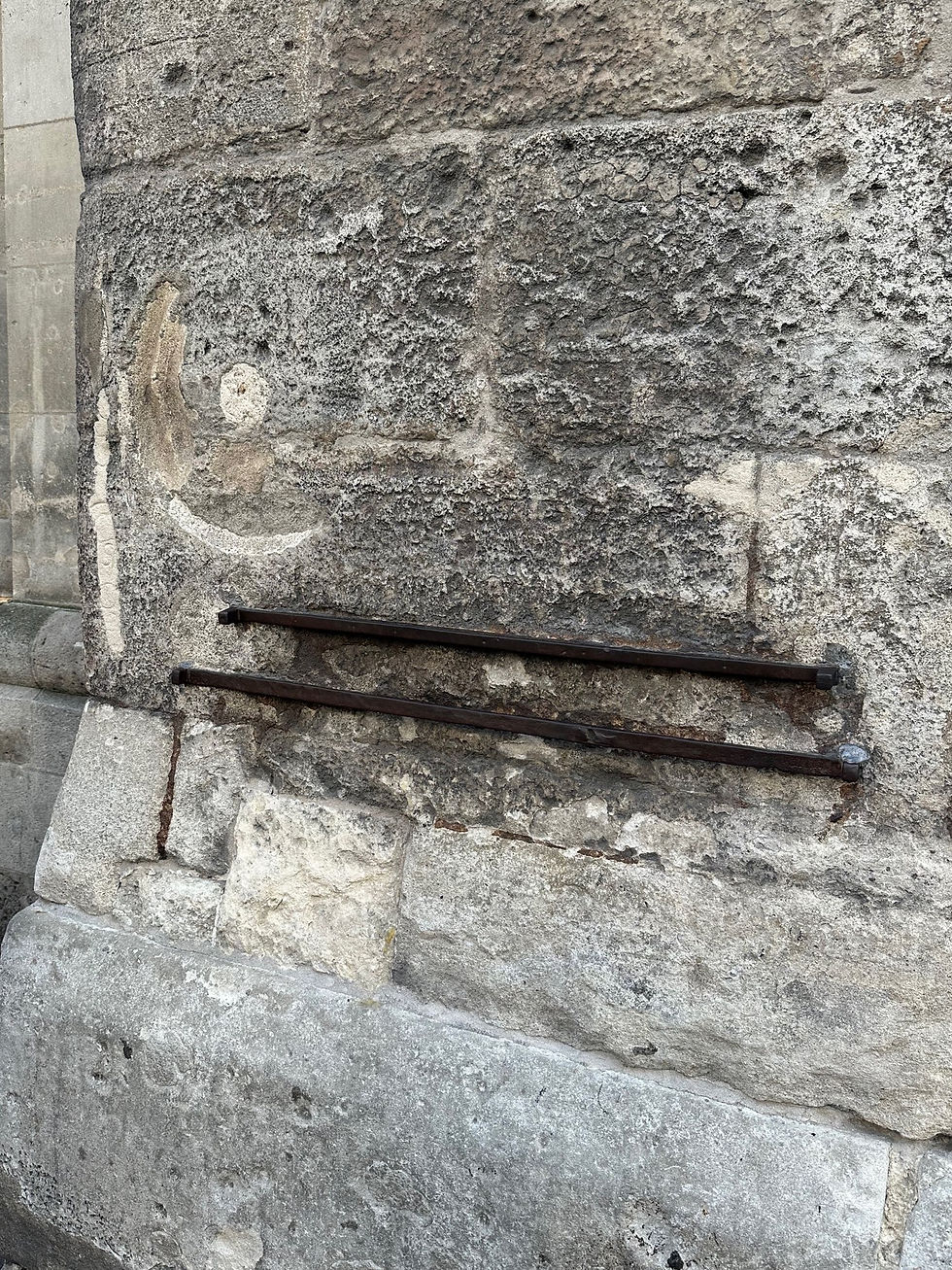
The two iron bars were for officially measuring cloth. The round mark above was to determine that a loaf of bread was the correct size.
And here is another historic parallel: Indy back in the day, showing these historic measuring tools to other Vienna visitors:

Isn't she cute???
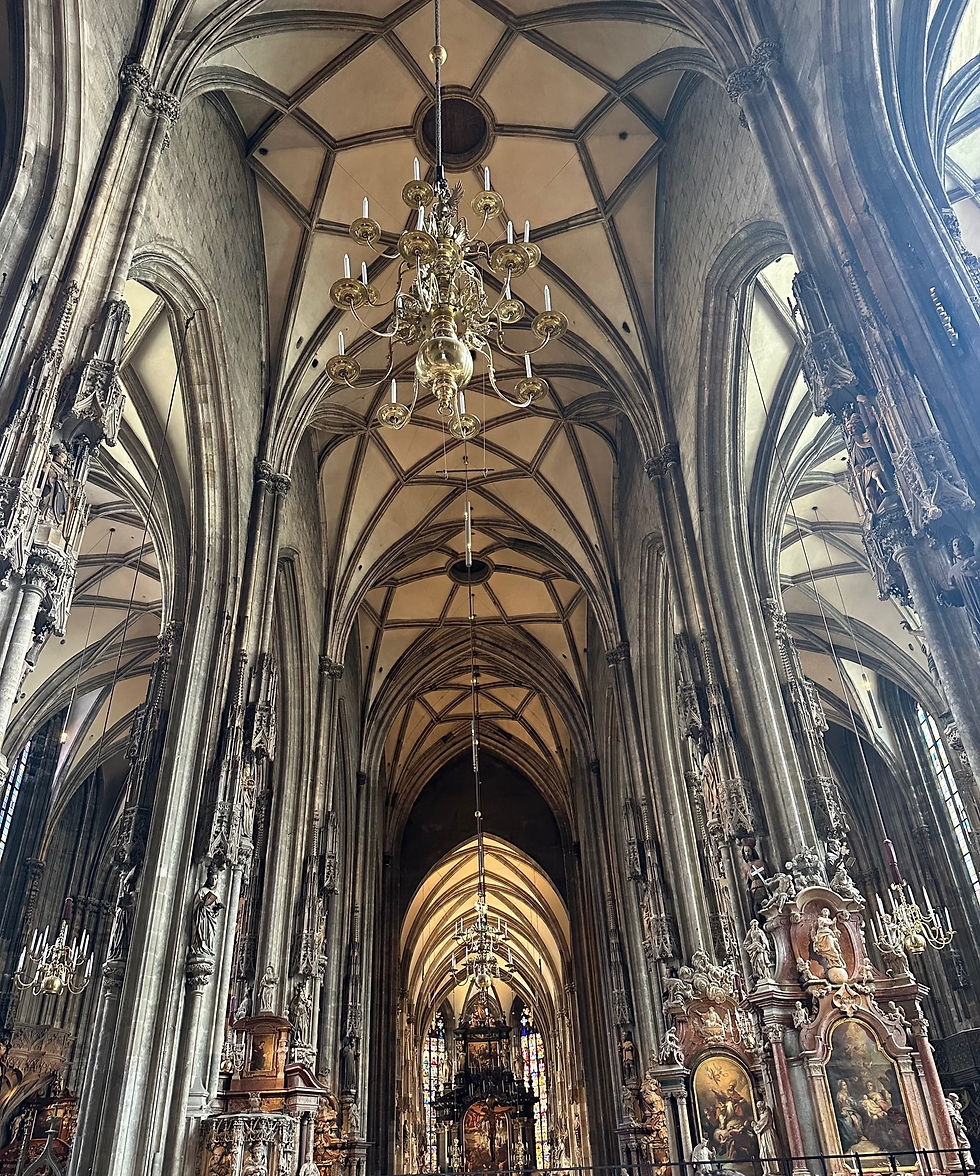
As with all the other cathedrals we'd seen, this one was just as beautiful and imposing and breathtaking.


Having gotten our daily cathedral "fix," we moved on to the next place Cindy wanted to visit. By first I just had to take a shot of the very fancy Rolex store entrance:

Our next stop was the Virgilkapelle, a church dating back to the Middle Ages, built in the early 1200s as the "capella subterranea" of a planned chapel in Early Gothic style. Around 1246 it was decorated with painted joints and Greek crosses with splayed arms in the alcoves. Later on, the Chapel of St Mary Magdalena was built above it (the outline of which is still visible today in the paving on Stephansplatz).
At some point, after the Chapel of St Mary Magdalena burned down, this subterranean chapel was forgotten. It was rediscovered when Vienna was building its subway and the Stephansplatz station. The entrance to the chapel was integrated into the design of the station...

...and the Wien Museum had a presence in the heart of the city.
This was a quiet, somewhat hidden, spot with an exhibit that we found really needed the audio guide. The best part of that audio guide was the music of the period accompanying all of the explanations. In there, it was hard to believe that thousands of people passed by the place daily--and perhaps never even noticed it.


Quite the gem.
Coming out of the ground once again, Edie wanted to stop in at a music store she frequented when she taught at International School--and yes, it was still there. While I waited outside, I saw, across the street, a wonderful Art Deco storefront (a coffee roaster and shop).

Back in the plaza, Edie and Cindy pointed out the Pestsäule, or Plague Column, commemorating those who died in the Great Plague epidemic of 1679.


Every inch of this column was wrapped in netting to keep the pigeons at bay. It seemed to work--and this was true of lots of the statues around Vienna.
It was time for something completely different: the Prater--more specifically, the Wurstelprater, an amusement park set in the Wiener Prater, a large park in Leopoldstadt. If you've ever seen The Third Man, you can probably remember the giant Ferris wheel (the Riesenrad)--and if you've watched the recent PBS series Vienna Blood, it's in the first episode as well as the opening credits.
This is one of the largest amusement parks I've ever seen; it seems to go on for miles. And by the time we arrived, it was hot and definitely time for lunch--but the beer garden we were looking for was far from the entrance. After wandering by an amazing array of rides and attractions, some traditionally found in places like this and others representing major technological advances, we finally found the place we needed--a beautifully shaded outdoor traditional beer garden. I was grateful to settle down for a while.
After lunch, we found our way back to the Riesenrad. It's de riguer to ride the Ferris wheel, and Cindy had been promising for years that someday we would do this. Someday had finally arrived. There was much to see on our way to the wheel itself, but it would take too long to describe (even if I could remember any of it).
After purchasing our tickets, we entered a round room with mirrored walls, a frieze around the upper part of the walls, and "retired" gondolas with dioramas depicting some of the city's history. There's just a whole lot of history in this place.

With reason: This park goes all the way back to the Austrian Empire, when Emperor Joseph II made the Prater (which had been serving as Imperial hunting ground until then) open to the public in 1766. Soon the first snack bars, stalls and bowling alleys opened up on the grounds and the Wurstelprater was born. To this day, most of the rides and attractions are individually owned; each one charges their own admission; and entry to the Wurstelprater itself is free.
So we finally found our way through the rotunda to the Riesenrad itself and boarded our car.

The view is, of course, spectacular.


The Riesenrad folks help to identify the views with panoramic images above the windows of the gondola:

We caught Edie in the act of not taking advantage of that helpful panorama....


We were all pretty tuckered out by the time we got back to our hotel after this day of wide-ranging adventures. I think everyone napped.
But the fun wasn't over. Weeks before, Cindy and Edie had made plans with their International School faculty friends Gordon and Cheryl to go to dinner at their place. It was going to be an exciting reunion after many years. But...my Covid positivity had thrown a wrench into those original plans. After much back and forth, it was decided that we would join Gordon and Cheryl in a park near their home for a picnic dinner.
It was a grand evening as they all caught up on 40 years of personal histories and mutual friends' stories--and I learned a lot about their time in Vienna. It was lovely to meet the two of them--and it was very generous of them to schlep all those dinner fixings to the park to accommodate the Covid crisis. Here we are in Türkenschanzpark:


In every way, it was a fine day, made special by
Cindy's busking memories and the evening's connections to that same time.
The next day, too, would have other new and retro experiences.


So cool to see the busker scene recreated! She doesn’t look much different:)